
Data Center vs Oil and Gas Careers: 7 Honest Differences 2026
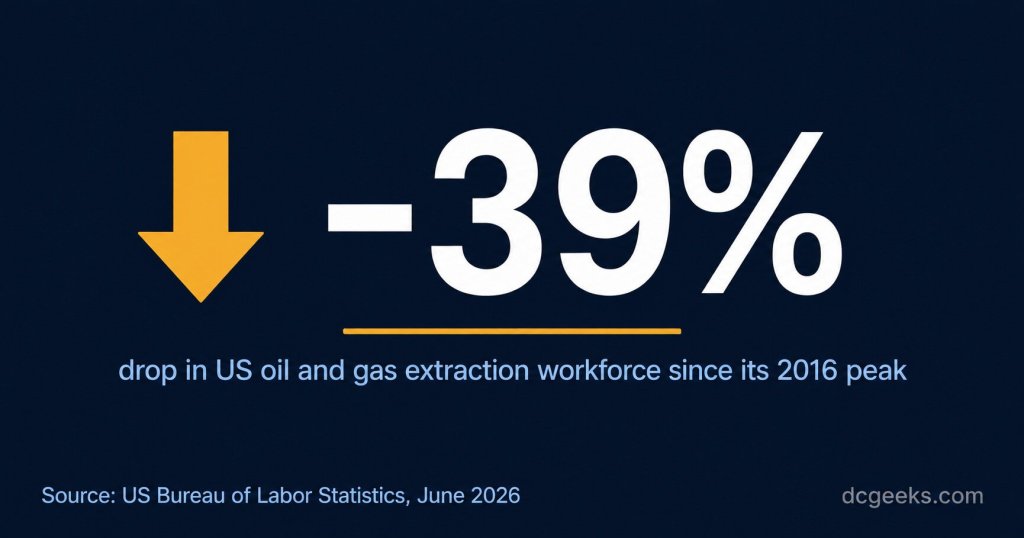
In June 2026, the US oil and gas extraction workforce fell to 114,500 workers, the second-lowest June total the Bureau of Labor Statistics has recorded since 2016.
The data center industry, by contrast, headed into 2026 with roughly 439,000 open positions and no relief in sight.
That gap sits at the center of any honest data center vs oil and gas career comparison.
One field is contracting after a decade of boom-and-bust cycles; the other cannot hire fast enough.
This guide breaks down pay, job security, transferable skills, daily work, and long-term outlook, so you can pick the field that fits your goals and your appetite for risk.
Both careers pay well above the national median wage, so this is not a question of good money versus bad money.
It is a question of which kind of good money you want, and how much stability you are willing to trade to get it.
Data center vs oil and gas careers at a glance
A data center career means building, operating, and maintaining the facilities that power the internet and AI, while an oil and gas career means finding, extracting, and processing the fuels that run the physical economy.
Both reward technical, hands-on people who like high-stakes systems, but they pull in opposite directions on growth and stability.
Here is the head-to-head for 2026.
| Factor | Data center careers | Oil and gas careers |
|---|---|---|
| Typical entry pay | $45,000 to $65,000 (L1 technician) | $34,000 to $56,000 (engineering technician) |
| Typical mid to senior pay | $80,000 to $115,000 | $88,000 to $155,000 |
| Top specialist pay | Up to $200,000 (AI infrastructure) | $200,000+ (drilling and field leads) |
| 10-year outlook | Strong growth, 780,000 jobs by 2030 | Flat, roughly 1% growth 2024 to 2034 |
| 2026 hiring climate | Severe shortage, 58% of operators short-staffed | Consolidation, near-record-low headcount |
| Boom-bust risk | Low, driven by structural AI demand | High, tied to the price of oil |
| Where the jobs are | Metros: Northern Virginia, Phoenix, Dallas | Basins: Permian, Midland, Odessa |
The pattern is clear before you read another word.
Oil and gas rewards its top specialists more richly, and data centers reward almost everyone else more reliably.
Pay: which field puts more money in your pocket
Oil and gas still wins at the very top, and data centers win across the broad middle.
Petroleum engineers earn a median of $141,280 per year, according to Bureau of Labor Statistics wage data from May 2024, which is higher than nearly every data center role short of specialized AI infrastructure work.

That figure is the headline number recruiters use to sell the industry, and it is real.
The catch is that petroleum engineering is one narrow, degree-gated role.
The broader oil and gas technician workforce averages closer to $56,000 per year, based on PayScale compensation data for petroleum and gas engineering technicians.
Data center pay lands between those two poles and keeps climbing.
A data center technician averages somewhere between $68,000 and $82,450 nationally in 2026, a spread that reflects honest divergence across BLS, Indeed, Glassdoor, ZipRecruiter, Salary.com, and the DataX Connect salary survey rather than one clean number.
The higher figures come from surveys weighted toward hyperscaler and Northern Virginia pay; the lower ones capture entry pools and staffing-agency roles.
Base pay in data centers has risen 14% to 22% across most roles since 2023 as operators fight over scarce staff.
Oil and gas pay is rising too, with 67% of industry professionals expecting a raise in 2026 per the Global Energy Talent Index, though that optimism sits against a shrinking payroll.
Job security and outlook: growing field vs boom-and-bust cycle
The biggest honest difference between these careers is not pay, it is stability.
Oil and gas employment rises and falls with the price of a barrel, and the swings are brutal.
The 2016 oil price collapse triggered mass layoffs, and the extraction workforce has shed roughly 72,800 positions since its January 2016 peak of 187,300, a drop of about 39% over a decade per Bureau of Labor Statistics payroll data.

Looking forward, BLS projects petroleum engineer employment to grow just 1% from 2024 to 2034, slower than the average for all occupations, with most of the roughly 10,600 annual openings coming from retirements rather than new demand.
Data center demand runs the other way, and it is structural rather than cyclical.
McKinsey projects US data center power demand will reach 80 gigawatts by 2030, triple the 2023 level, and nearly all of that growth is AI workload.
The Bureau of Labor Statistics counts 780,000 projected data center jobs by 2030, and the Uptime Institute’s 2024 Global Data Center Survey found that 58% of operators struggle to find qualified candidates.
JLL reports that 90% of operators cite staffing shortages as a constraint, and nobody on the operator or recruiter side forecasts that gap closing before 2028.
If you value a paycheck that survives a bad year in your industry, that contrast should weigh heavily.

Skills that transfer from oil and gas to data centers
If you already work in oil and gas, a large share of your skills maps directly onto data center roles.
Both industries run mission-critical, 24/7 environments where a failure costs real money, and both live on electrical, mechanical, and controls expertise plus a serious safety culture.
That overlap is why oil and gas workers are one of the smoother trade-to-tech transitions into the field.
| Oil and gas skill | Data center equivalent |
|---|---|
| Rotating equipment and turbine upkeep | Generator and UPS maintenance |
| Instrumentation and SCADA controls | DCIM and building management systems |
| High-voltage electrical work | Power distribution, switchgear, PDUs |
| Process safety and OSHA compliance | Data center safety and compliance |
| 24/7 shift and rotation operations | Critical facility shift operations |
The credential gap is smaller than most people expect.
Day-to-day work and lifestyle differences
The daily experience of these two careers looks very different once you leave the salary spreadsheet.
Oil and gas work often means remote sites, fly-in-fly-out rotations, and long stretches around production hubs like the Permian Basin near Midland and Odessa.

The pay premium partly compensates for that distance, the physical demands, and the ever-present risk of a price-driven layoff.
Worker appetite for that trade-off is fading, with only 75% of oil and gas professionals now willing to relocate for a job, down from 89% in 2022 per the Global Energy Talent Index.
Data center work is more rooted.
Facilities cluster in fixed metros such as Northern Virginia, Phoenix, Dallas, and fast-growing secondary markets like Columbus, so most technicians work shifts and sleep at home the same night.
The environment is indoor and climate-controlled, the work is steady, and the growth curve means your employer is far more likely to be expanding than cutting.
Neither lifestyle is objectively better, but they attract different people, and knowing which one you are saves you an expensive career detour.

Which career is the better bet in 2026
Here is the straight answer, no hedging.
If you want the highest possible single-role ceiling, you can commit to a petroleum engineering degree, and you can stomach the cycles, oil and gas still pays the most at the very top.
For almost everyone else, data centers are the stronger bet in 2026.
You get a growing field, pay that has climbed 14% to 22% since 2023, faster entry without a four-year degree, and dramatically better job security.
Career changers already working in electrical, mechanical, or field-operations trades get the best of both worlds: a short runway in and a long growth curve once inside.
The industry that cannot stop hiring is a safer place to build 20 years than the industry cutting headcount to a decade low.
Frequently Asked Questions
Do data center jobs pay more than oil and gas jobs?
At the very top, oil and gas still pays more, but data centers pay better across the broad middle. Petroleum engineers earn a median of $141,280 per year (BLS, May 2024), higher than most data center roles. Data center technicians average roughly $68,000 to $82,450 nationally in 2026, and senior or AI-infrastructure specialists can reach $115,000 to $200,000.
Is it hard to switch from oil and gas to data centers?
No, it is one of the more natural trade-to-tech moves available. Oil and gas workers bring electrical, mechanical, controls, and 24/7 high-reliability operations experience that data center employers actively want. Most people need targeted upskilling in data center specifics rather than a full four-year restart, and can review our data center technician career path to map the steps.
Which industry has better job security, data centers or oil and gas?
Data centers, by a wide margin in 2026. Oil and gas extraction employment is cyclical and has fallen about 39% from its 2016 peak to 114,500 workers in June 2026 (BLS). Data centers face a structural staffing shortage, with 780,000 jobs projected by 2030 and 58% of operators reporting they cannot find qualified staff.
The bottom line for your next move
Oil and gas offers a higher ceiling for degree-holding specialists, but it pays that premium inside a shrinking, cyclical industry that just hit a decade-low headcount.
Data centers offer rising pay, easier entry, and the rare combination of a technical career with genuine long-term security, backed by 780,000 projected jobs and a shortage no one expects to fix soon.
If you are weighing the switch, start by matching your current skills against real data center roles and their pay, using our data center technician salary guide as a baseline.
Then pick one certification to close the gap, and subscribe to the dcgeeks.com newsletter for new salary data and hiring signals as the market moves through 2026.
The field that keeps posting jobs is the one worth betting your next decade on.


